
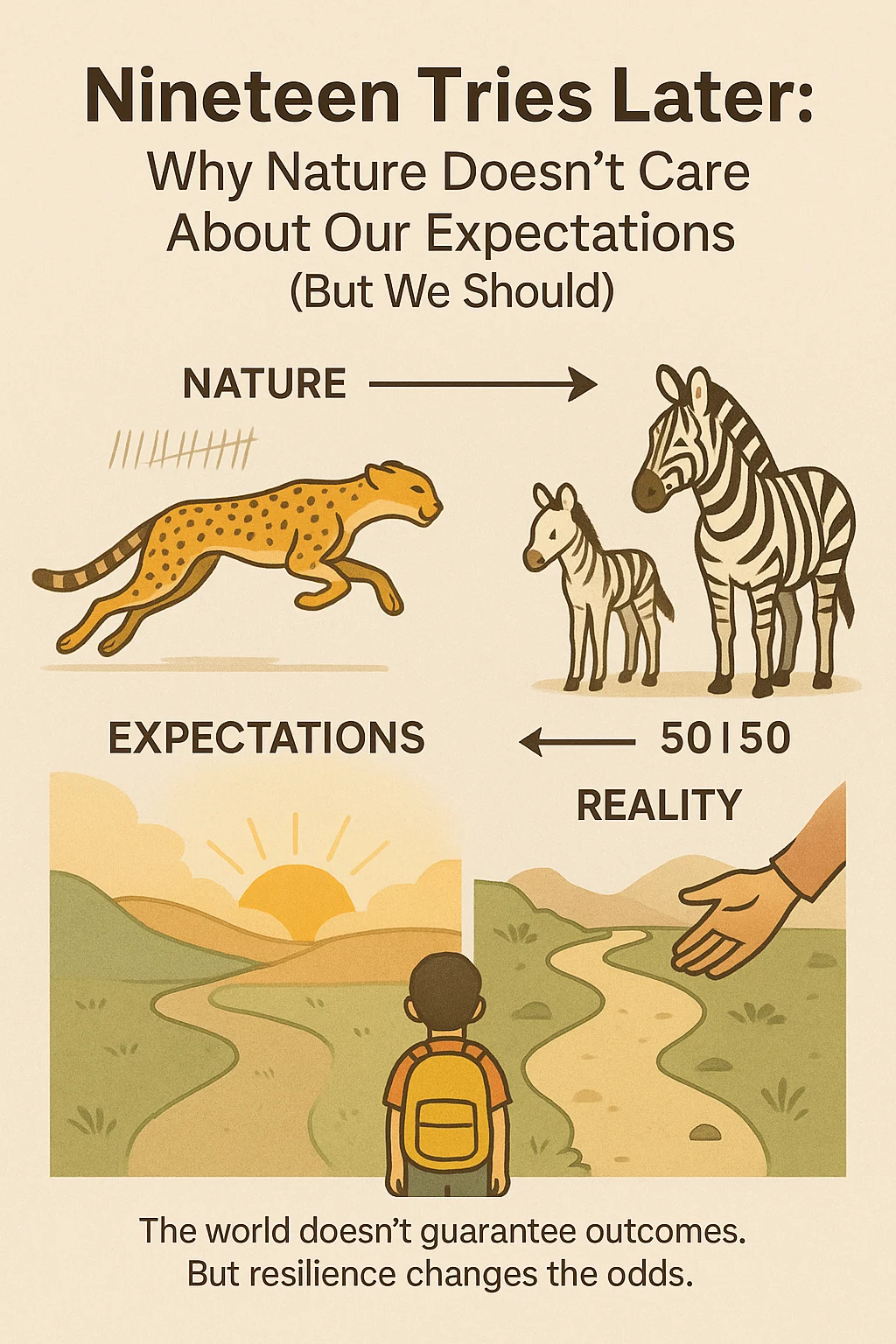
Parents love guarantees. We want to believe that if we speak seven positive affirmations before breakfast and sign our kids up for enough enrichment classes, we can smooth out every bump in their future. The problem is, biology never signed that contract with us.
Take the cheetah. Fastest land animal on Earth. Built like a missile. And yet? It fails nineteen times before it finally brings down an antelope. Nineteen. If a cheetah quit after attempt nineteen, it wouldn’t be a motivational quote — it would be a skeleton. That’s nature’s quiet reminder: success is messy, uneven, and statistically brutal.
Zebras? Only half of those adorable striped fluffballs make it to adulthood. Half. I’m not suggesting we start applying Serengeti rules to American parenting. We’re not trying to lose fifty percent of the freshman class to “character-building experiences.” But it’s a reminder that the universe does not stack the odds in anyone’s favor, including our kids’. The world is not built to guarantee outcomes, no matter how many flashcards we buy.
We forget this because we live in an era of curated perfection. Kids judge themselves against influencers who haven’t even hit puberty without a filter. Parents judge themselves against other parents performing “effortless” success on Instagram. The result? A generation that thinks if they aren’t instantly brilliant, instantly confident, instantly exceptional, something is wrong with them.
Nothing is wrong with them. What’s wrong is the expectation.
Nature gives every kid raw material. Nurture shapes it. But the equation was never designed to deliver a perfect product. It was designed to produce a human who learns, fails, adjusts, fails again, cries, tries, falls, stands, and eventually finds footing.
That is how confidence is built. That is how resilience gets wired. And that is how reality wins against the fantasy that everything should come easy.
Our job as parents isn’t to remove struggle. It’s to teach our kids that struggle is normal. That nineteen failed attempts don’t say anything about their worth. That the world is competitive not because it hates them, but because that is how nature writes the rules.
If we can teach our kids that expectations should be anchored to effort, growth, and patience — not to instant success — we give them something far more powerful than protection. We give them immune systems for life.
And unlike cheetahs and zebras, our kids actually have a chance to tilt the odds in their favor. But only if we stop pretending the world owes them wins just because we want it to.
We can’t change nature… but we can prepare our kids for it.
Grab a free chapter or test-drive the DEOR Calculator and start giving your kid the roadmap the world forgot to provide.